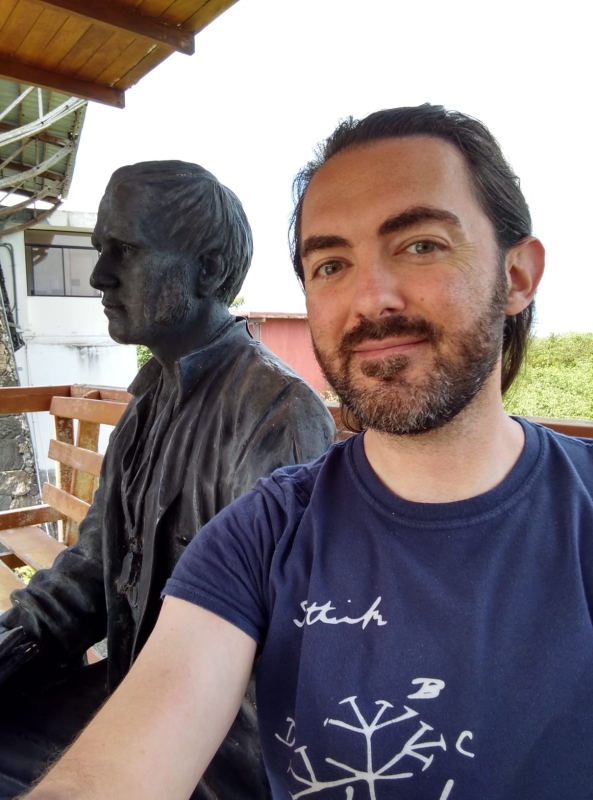
Hi! I’m Ash
And this is my dear friend, Charles. I’m traveling the world, retracing the footsteps of Darwin and some of the other great thinkers in the history of biology, as I work on writing my book on evolutionary theory. It’s called On the Destiny of Species: How Evolution Evolves. It’s a deep dive into how, and why, the process of evolution itself changes over time, with an emphasis on the directionality of evolutionary change and how phenomena such as meaning and purpose emerge from its first principles, and developing key concepts like function and adaptation (as well as introducing some new ones). Darwin largely answered the big questions about where we came from and how we got here—I want to complete his work by answering questions about where we’re heading and how we’ll get there. I’ll be writing a lot more about these ideas (and much more) here on my blog, which will be part travel journal, part daily gratitude practice, and part random musings about life, the universe, and everything. Enjoy!
Who is Charles Darwin?
Charles Darwin was a naturalist and biologist most well known for his theory of evolution and his understanding of the process of natural selection. In 1831, he embarked on a five-year voyage around the world on the HMS Beagle. He also studied geology, zoology, and botany in the Galápagos Islands. South America, the Pacific Islands, and the Galápagos Archipelago were of particular interest to Darwin. Upon his return to England in 1836, Darwin began to write up his findings in the Journal of Researches, published as part of Captain FitzRoy’s larger narrative and later edited into the Zoology of the Voyage of the Beagle. The trip had a monumental effect on Darwin’s view of natural history—and through him, that of the world. Over the course of his voyage, Darwin collected a variety of natural specimens, including birds, plants and fossils. He began to develop a revolutionary theory about the origin of living beings that ran contrary to the popular view of other naturalists at the time. His studies led him to the formulation of his theories, which, in 1859, he published in his book, On the Origin of Species.

